

Microsoft recently announced the end of Azure Reservation exchanges. Starting February 1, 2027, newly purchased Reservations will no longer be eligible for exchange on Azure services coverable by Savings Plans. Presently, that includes compute (e.g., VMs, App Service) and database (e.g., SQL, MySQL, PostgreSQL) services. Also, starting February 1, 2027, Reservations purchased prior to that date will be eligible for one final exchange.
This isn’t Microsoft’s first attempt at this change. In October 2022, Microsoft announced that Reservation exchanges would end for Reservations purchased after January 1, 2024. Due to customer feedback, that deadline was extended to July 1, 2024, and eventually postponed “until further notice.” This latest announcement is the (final?) follow-through on a change Microsoft has been trying to implement for years.
Why Is Microsoft Making This Change?
Understanding why Microsoft is doing this requires understanding how we got here. Over the years, Microsoft has evolved its commitment-based discount strategy in direct response to AWS:
- 2009 — AWS introduces Reserved Instances (later known as Standard RIs): a high discount, tied to specific instance types.
- 2016 — AWS releases Convertible RIs: a comparably lower discount, but with more flexibility (exchangeability within a region).
- 2017 — Azure responds with Reservations: a high discount (targeting AWS Standard RI rates) and global exchangeability (the announcement cites “unprecedented flexibility”) making them superior to AWS RIs.
- 2019 — AWS releases Savings Plans: Compute Savings Plans in particular offer the same lower discount as Convertible RIs with automatic float to global usage.
- 2022 — Azure responds with Savings Plans for Compute: matching AWS functionality at a lower discount (comparable to AWS Savings Plans and Convertible RIs). At the same time, Microsoft announces its intent to remove Reservation exchanges.
So why has Microsoft been attempting to remove Reservation exchanges since 2022? Our belief is because the back-and-forth with AWS left Microsoft with a product rationalization problem: two offers providing similar flexibility at very different discount rates.
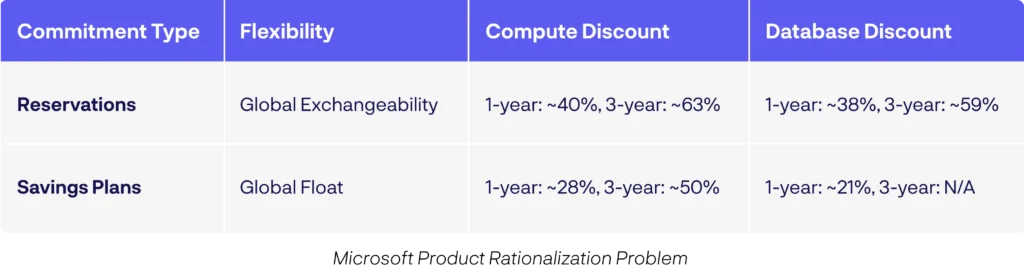
The discount gap is significant. 1-year compute Reservations typically offer 43% more savings than Savings Plans, and 3-year compute Reservations offer 26% more savings.
For database services, 1-year Reservations offer a whopping 81% more savings than Savings Plans, but the most significant impact is on 3-year discounts since there is currently no 3-year Savings Plan for databases. Prior to the change, customers could receive a 59% discount with global flexibility using Reservations. After the change, there is no way to receive 3-year discounts with flexibility. We hope Microsoft introduces a 3-year Savings Plan for databases before February 1, 2027. 🤞 (An observation: AWS doesn’t offer 3-year Database Savings Plan discounts either, so we hope we’re not on an AWS timeline in order for Microsoft to follow suit.)
While Microsoft could have rationalized this product problem in multiple ways, they chose to address it by taking away functionality from Reservations, a solution that will undoubtedly frustrate many Azure customers.
TL;DR – What Does This Mean For Me?
As a FinOps company whose mission is to help customers optimize their cloud bills, we view removing flexibility that generally reduces customer savings as a step backward, not forward. The loss of flexibility, paired with the loss of discount, makes it more difficult for customers to confidently scale, and we’ve seen more customers adopting multi-cloud strategies to maximize their optionality.
That said, Reservations are not going away. Microsoft’s announcement states that “Reservations remain an important commitment-based discount offering.” Exchanges will no longer be available, but other Reservation capabilities remain unchanged (e.g., the $50,000 Reservation cancellation policy).
We expect this change will push many (possibly most) customers away from Reservations and toward a predominant or exclusive Savings Plan strategy.
The timing of this announcement is particularly relevant. We recently released our first Azure Compute Rate Optimization Insights Report, which showed that the H1 2026 median All-Discounts Effective Savings Rate (ESR) on Azure compute was 30%, and 3-year VM Reservation adoption was 66%, the highest of any commitment type and term. We fully expect this change will decrease the median ESR beginning in 2027 since customers will save less as they more heavily favor Savings Plans.
Does This Impact ProsperOps?
Microsoft signaled this change well in advance, and we’ve planned for this eventuality. Understanding the complexities, possibilities, and evolution of commitment-based discounts (across AWS, Azure, and Google Cloud), and automating the best possible outcomes, is what we do. While the removal of Reservation exchanges will generally lower customer median ESRs, our platform strategies were designed to evolve and adjust to deliver the highest relative savings outcomes. Some of our tactics will change, but Adaptive Laddering, blending a portfolio of Reservations and Savings Plans, optimizing for cyclical patterns, and handling aggregate increases and decreases in dynamic global usage, remain unchanged. Our strategy will continue to maximize savings outcomes, minimize Commitment Lock-in Risk, and remove rate optimization toil so our customers can focus on higher value FinOps activities.
We are actively working to support this change. If you already use ProsperOps, there is nothing you need to do—our platform will automatically manage this transition for you, and our team will proactively reach out if any setting adjustments are necessary. We will maximize your savings until and after the change on February 1, 2027.
What Should I Do Now?
If you are managing Reservations today, you have 6 months to determine your go-forward rate optimization strategy. Does the loss of exchange flexibility fundamentally make the use of Reservations less viable? If you find yourself leaning toward a Savings Plan-only strategy, consider the loss of savings and remember that Savings Plans are immutable commitments. Once you purchase them, you have no ability to alter them until the term expires.
If you would like to explore how ProsperOps can autonomously deliver savings outcomes to your organization, or you no longer wish to tactically manage Azure Reservations and Savings Plans, we offer a free Azure Savings Analysis that will quantifiably project our impact in your specific environment. The process is lightweight and will provide the data you need to make an informed decision.
There is a window between now and February 1, 2027. Getting started with ProsperOps before the change will uniquely position you to maintain higher levels of savings and flexibility in 2027 and beyond.
You can sign up for an Azure Savings Analysis here: https://www.prosperops.com/products/azure-cost-optimization/.
Our mission is to help businesses prosper in the cloud. This always matters deeply to us, but is acutely important through changes like this.
Prosper On! 🖖
Erik