


Amazon RDS Reserved Instances can lower database costs for steady AWS workloads, but they only deliver the best results when your usage is predictable. This article explains how RDS Reserved Instances work, when they make sense, and which tradeoffs matter before you commit.
When managing resources in the cloud, whether on AWS,Google Cloud Platform, orMicrosoft Azure, getting the most value for your spend is key to driving business value.
AWS RDS Reserved Instances (RIs) help you minimize costs compared to On-Demand pricing while delivering equivalent performance levels. However, you need to understand the nuances of RDS RIs, such as payment options and flexibility within database engine families, in order to optimize your AWS spend.
This article details the benefits and important considerations of AWS cost optimization with RDS Reserved Instances. You’ll discover how to secure savings while ensuring efficient database operations on Amazon’s cloud platform.
At a high level, Amazon RDS Reserved Instances lower cost versus On-Demand pricing when you commit to specific database usage for a one- or three-year term. They are most effective for steady workloads and require careful forecasting to avoid unused commitments.
Key Takeaways
- RDS Reserved Instances are best aligned to stable and predictable database demand.
- RDS Reserved Instances can reduce costs by up to 69% compared to On-Demand pricing, depending on term length and payment option.
- Terms last one or three years, so commitment planning matters as much as rate savings.
- Budget predictability can improve, but flexibility is lower than with On-Demand Instances.
- Forecasting, coverage monitoring, and changing infrastructure needs are the main operational challenges.
What are RDS Reserved Instances (RIs)?
RDS Reserved Instances are long-term reservations that offer significant cost savings over On-Demand pricing in exchange for a commitment to specific database instances for a one- or three-year term.
For a broader overview of the service itself, see Amazon Relational Database Service.
This model provides a predictable cost structure, which can lead to greater savings as you scale your operations within AWS.
However, remember that RDS is available in various instance types, each tailored to different workloads and performance requirements. Therefore, when choosing RDS Reserved Instances, it’s crucial to select instance types that align with your use cases to ensure maximum efficiency and cost-effectiveness.
But Reserved Instances aren’t just about lowering costs. They also support capacity reservation in defined Availability Zones.
That reservation can help maintain scalability and performance stability for applications that need consistent database access and uptime.
By leveraging RDS RIs, you can manage your budget more effectively while still benefiting from the scalability and performance of AWS database services. This is a solid approach for cost control and operational stability.
How RDS Reserved Instances work
By opting for a Reserved Instance, you commit to a specific type of instance and benefit from a lower price than On-Demand pricing. This can be especially cost-effective for databases that run continuously.
For AWS billing, Amazon automatically applies the reserved rate to eligible DB instance classes.
The instance pricing discount depends on:
- The DB instance type you commit to
- The specific DB engine you’re using
- The commitment term (one or three years)
This pricing model optimizes costs while effectively meeting your database needs.
RDS Reserved Instance payment options
The pricing model for Amazon RDS Reserved Instances centers around the idea of commitment and upfront payment.
Similar to EC2 Reserved Instances, you get three payment options: No upfront payment, Partial upfront payment, All upfront payment.
- No upfront payment: “No upfront payment: You pay nothing upfront but commit to monthly payments over the term. This option typically offers the lowest discount of the three.”
- Partial upfront payment: You pay a part of the cost upfront, and the rest is spread out over the period.
- All upfront payment: You pay the entire cost upfront in one lump sum, receiving the largest discount.
Going with all upfront can yield the most cost savings, as it typically offers the highest discount.
What are the use cases of RDS Reserved Instances?
Leveraging RDS Reserved Instances can be a smart financial move in scenarios where consistency and long-term planning intersect with a desire for cost-effectiveness.
RDS RIs are especially useful in three situations.
Stable and predictable workloads
Reserved Instances should be your go-to choice when you have workloads that don’t fluctuate much. If your database needs are stable and predictable, RIs provide guaranteed cost savings and help you maintain performance levels without hiccups.
Long-term commitment
When you can predict long-term usage of Amazon RDS, Reserved Instances can be a worthwhile investment. By committing to either a one-year or three-year term, you can secure a lower price than On-Demand and leverage the discount for long-term resource management.
Your commitment to a Reserved Instance means both savings and the peace of mind that comes from knowing your database has its place secured on the cloud.
Cost-optimization focus
Reserved Instances are also ideal if you’re implementing FinOps and taking steps to optimize your cloud spend. You can leverage significant savings if you’re good with RI usage tracking, forecasting, and overall RI management.
However, managing AWS RDS Reserved Instances comes with its own unique set of challenges. If your usage predictions are off or your needs unexpectedly change, you may end up paying for RIs you don’t need anymore. Thus, a cautious approach is highly recommended.
On-Demand Instances vs. Reserved Instances
When you’re using AWS RDS services, you’ll encounter two primary pricing models: On-Demand Instances and Reserved Instances. Understanding the differences between them is crucial to optimizing your costs.
On-Demand Instances are the go-to for flexibility. You pay hourly rates for compute and database capacity as and when needed, with no long-term commitments.
This flexibility is ideal for managing unpredictable workloads or sudden spikes in demand, as it allows you to avoid long-term contracts. However, this convenience comes with a higher cost.
Reserved Instances, on the other hand, focus on savings and predictability. By committing to a one- or three-year term, you can save significantly over On-Demand pricing.
Here’s a quick comparison:
| Feature | On-Demand Instances | Reserved Instances |
| Pricing | Higher hourly rates | Lower hourly rates with upfront payment |
| Commitment | No long-term commitments | 1- or 3-year term |
| Flexibility | High | Lower due to the commitment |
| Ideal for | Unpredictable workloads | Steady or predictable workloads |
| Potential cost savings | None | Up to 69% compared to On-Demand pricing |
If you’re considering Reserved Instances, make sure you have a thorough understanding of your usage patterns; otherwise, you could be trapped in negative savings over the long run instead.
Why RDS RI commitment management is challenging
Managing your RI commitments can be challenging.
- The diversity and volume of Reserved Instances — each with different tenures, expiration dates, and specifications — make monitoring and management complex.
- You also need to monitor utilization closely so you don’t overuse or underuse your commitments.
- Forecasting is difficult because shifts in product demand or organizational policy can quickly change database requirements.
- Fear of overprovisioning can lead teams to under-commit and leave savings on the table.
Secondly, forecasting usage is challenging because of the uncertainties involved.
Understanding cyclical workloads also matters when deciding how much Commitment Lock-In Risk (CLR) to accept. CLR measures the weighted average duration of your active commitment portfolio — the longer your commitments relative to your workload stability, the higher your exposure when demand changes.
Ultimately, effectively managing RIs requires a balanced approach that accommodates both current and future business needs.
Benefits of RDS Reserved Instances
Cost savings
These savings can be as high as 69%.
AWS documents current discount levels for AWS RDS Reserved Instances.
The longer the term and the more you pay upfront, the greater the savings you’ll realize.
Budgeting and planning
RDS Reserved Instances offer predictability. Knowing your costs upfront helps you plan your budget more effectively.
This allows for a more strategic approach to managing your AWS spending, transforming variable costs into fixed ones.
This predictability also helps you achieve cost efficiency. In turn, your business can allocate future resources more effectively.
Capacity reservation
RDS RIs also support capacity reservation in defined Availability Zones.
Securing capacity ahead of time can reduce provisioning risk during peak demand and simplify operational planning.
Flexibility
Size flexibility allows you to adjust the instance size as your needs change without altering the advantages of the reservation. However, you do have to stay within the same instance family and database engine.
AWS documents how you can adjust the instance size within those rules.
AWS uses a normalization factor to define the scaling of RDS RIs for Instance Size Flexibility. The image below represents the normalization factors for several instance types.
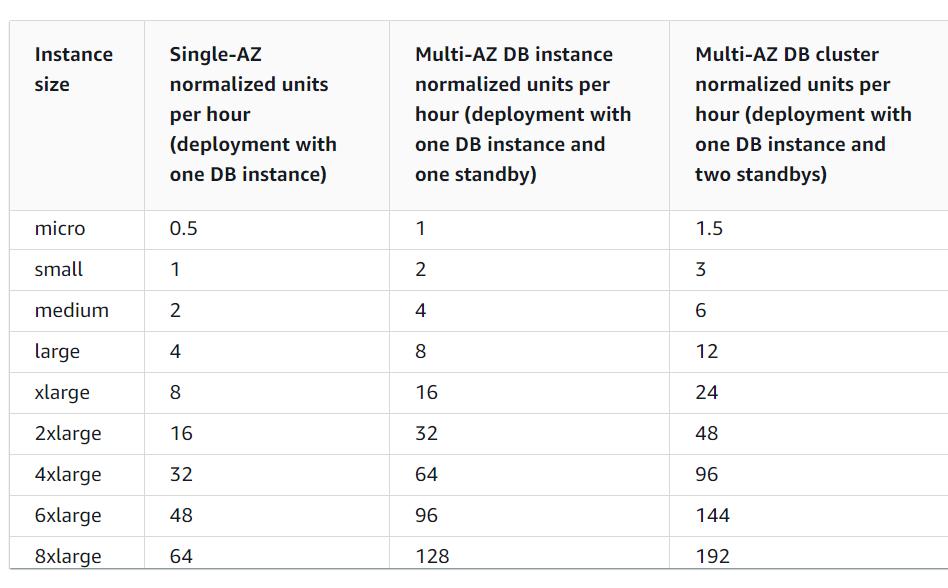
Image source: RDS Reserved Instance documentation
Understanding and using RDS Reserved Instances effectively can position you for optimized cost management and operational efficiency in your AWS environment.
Limitations of RDS Reserved Instances
Although Reserved Instances offer substantial savings on Amazon RDS usage, it’s important to understand their limitations before purchasing.
Upfront commitment
You’re making a commitment when opting for Reserved Instances. This means you agree to use and pay for the instance over a set period (one or three years).
While you benefit from a reduced hourly rate compared to On-Demand Instances, the commitment and initial upfront payment (if chosen) can be a major consideration for cloud management.
Non-refundable
Reserved DB Instances are generally non-refundable, so they need careful planning before purchase. Once you’ve paid for a Reserved Instance, AWS does not offer a refund or credit for the upfront payment, even if you no longer need the reserved capacity.
EC2 Reserved Instances do allow resale and exchange options that RDS RIs do not. See EC2 RIs for comparison
Geographic and instance-type inflexibility
Each Reserved Instance is restricted to a specific AWS region and instance type.
If your workloads shift to a different region or require a different instance type, the Reserved Instance can’t flex to accommodate those changes.
Potential for cost inefficiencies
While RDS Reserved Instances can lead to savings, they can also create cost inefficiencies if you don’t use them optimally.
If you underutilize the Reserved Instance during the term, you still have to pay for those unused commitments.
Conversely, if your usage exceeds the RI or requires different instance types, you’ll incur on-demand rates. Either way, you lose money.
This is why it’s important to thoroughly analyze your usage patterns to maximize your savings and prevent waste.
Complexity in management
Managing Reserved Instances also introduces complexity:
- Keeping track of your Reserved versus On-Demand Instances
- Monitoring utilization vs. coverage analysis
- Preventing under-usage of RIs
- Gaining RI visibility using tools like the AWS Management Console or the AWS CLI
These become ongoing operational tasks, which is why a clear understanding of RDS RIs and some level of automation can help.
Refine Reserved Instance management with ProsperOps
Managing RDS Reserved Instances can be a juggling act. RIs can maximize your savings, but this comes with the complexity of forecasting usage and handling ever-changing commitments.
This is where ProsperOps steps in: to simplify the process and enhance cost optimization.
ProsperOps delivers cloud savings-as-a-service. Our platform automatically blends discount instruments to maximize your savings while minimizing commitment risk.
Our automated FinOps platform streamlines cloud cost management by eliminating the effort and latency involved in manually managing rigid, long-term discount instruments.
We achieve this without disrupting your financial or engineering processes, reducing friction and allowing your team to focus on their day-to-day duties.
With ProsperOps, you pay nothing unless we save you money!
Ready to take control of your RDS RI cost management strategy? See ProsperOps in action. Request a demo today.
FAQs
What are Amazon RDS Reserved Instances?
Amazon RDS Reserved Instances reduce the price you pay for eligible database usage when you commit to a one- or three-year term. They are designed for workloads that run consistently enough to justify a longer commitment. The savings can be meaningful, but only if your actual usage stays aligned to what you reserved.
When do RDS Reserved Instances make sense?
They make the most sense when your database demand is stable and predictable over time. They are often a better fit for long-running production workloads than for short-lived or highly variable environments. If your requirements change often, the commitment can reduce the savings you expected to capture.
How are RDS Reserved Instances different from On-Demand Instances?
On-Demand Instances prioritize flexibility because you pay as you go with no long-term commitment. RDS Reserved Instances trade some of that flexibility for a lower rate over a one- or three-year term. That makes On-Demand a better fit for unpredictable workloads and Reserved Instances a better fit for steady usage.
What are the main limitations of RDS Reserved Instances?
The main limitations are Commitment Lock-In Risk (CLR), lower flexibility, and the operational effort required to manage utilization well. Region and instance-type constraints can create inefficiency when workloads move or change. Teams also need strong forecasting and monitoring to avoid paying for unused commitments.